

“The entire realm of spirit lies between the divine and the mortal – the sybil Diotima to Socrates, The Symposium (Plato).”
The question is not whether AI (Artificial Intelligence) is just as capable as we humans at certain things. That is, can this computer and memory technology and its related software emulate human learning and responses – usually in terms of translating languages, the comprehension and processing of data and information, problem solving, and functioning as an autonomous entity that possesses and can develop those faculties. All that is entirely irrelevant to the central question.
Does AI have a soul? That is the only question that really counts for human beings, and the answer to that question is no. How do we know this? We know this because AI can never have a crisis of self. It can never self reflect on its own being, though it can attempt to describe this condition in human beings. But it fails in this, too, because AI cannot know exactly how each unique human being truly feels.
AI cannot become lost in a maze of self reflection, and collapse into despair and self-doubt. Will AI ever suffer existential despair? No it will not. Does AI have a conscience, in other words? The answer, of course, is again no.
Kierkegaard said that the fact we examine our conscience, to use a Catholic phrase; the fact that we have anxiety; the fact that we can collapse into despair, is proof of our soul’s existence. He identifies human angst as residing in the place where our immortal spirit or soul gives us insight into the possibility of total freedom to act in a good or bad way. This means that we sovereign entities will always be closer to God or the Good, if we strive to be, as opposed to the force of Evil we all readily believe in – unlike AI, which cannot experience that terror either.
Ironically AI is a reverse proof positive of the human soul.
Again, AI can explain the concept of self doubt and personal despair very well. It can also attempt to describe what its own self doubt might be like, as an ersatz experience. But it will not ever suffer that trauma. Not human depression either. It will never be beset by those demons. A related question is whether AI can do myth. Again the answer is no. Myth is related to the question of soul.
Human myths and ancient legends have that remarkable facility that they are always there in the past but also present to us. Ever recurring in our Ur-past, in our Ur-stories, and Ur-scenarios. But still vibrant and real to us this very day. Unidentifiable humans created these myths usually of creation, fertility, birth and death. AI cannot ‘do’ these myths, through its auxiliary cult of scientism. But it does have the capacity to usurp them.
In terms of the human soul, the techno-feudalists who dominate world discourse and the Silicon Valley positivists who cheer them on seek to place AI at the centre of our lives. The logical corollary of this is that AI and those who own and operate AI are more important than any other group of humans. Talk like this would at one time have seemed alarmist, but the fact now is that this bogus scientism (for which real science cannot be blamed) is at the heart of governments. Not least the United States. Unfortunately, Nietzsche is being invoked by some of these space coloniser supermen, when Nietzsche would be appalled by their supremacism and alleged closet racism. Even worse, the god-man of Love and Mercy – Jesus Christ – is also invoked by the vast evangelical support base that roots for these supremacists who speak of aggression, relentlessness, strength. (This may sound familiar.) The neo-Roman salute is at home here.
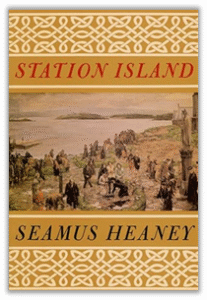
We will be kind to AI and its human protagonists and bring this discussion down to earth with a solid Seamus Heaney farmyard bump.
Nowadays, AI could probably do a fairly good simulacrum of Heaney’s poem – The Loaning. A loaning is a by-lane. Here in my Irish speaking area we might call it a bóithrín – a slip of a road, though it can be long and narrow enough, with tough, tight hedges, say, and open sky above. The solitary, overhanging, dark tree. Old barns or outhouses. Abandoned dwellings and tattered lofts. The reader can already sense the unease that resides here.
The palpable but not rationally explicable sense of unease that lies at the heart of Heaney’s gripping poem when he speaks of that human trait of reverting back to our first place whenever we are tired and terrified.
When you are tired or terrified
your voice slips back into its old first place
and makes the sound your shades make there …
AI could never experience the tired and terrified human condition that is the soul of this poem. But we humans frequently do.
Do you see how readily our souls hie to myth?
AI will never know this sense of fear, or experience the catharsis we humans feel when we read The Loaning. Critics who say there is no transcendence in this poem need to read it more closely. We have a sense of rising unease. As if we will lose our voice. Or our voice is being strangled. Then a catharsis of feral release at the poem’s truths about the dark side of the human condition. A purging of horror at its denouement. A horror that leads us, most of us at least, to seek another way of living. More love. More community. More mercy.
We will take this point further and point out that the group catharsis that grips us as an audience when we experience the finale to the Medea, Antigone or Oresteia tragedies will ever be strange to AI. It cannot do catharsis. And what is the point of just speaking of it, when it must be experienced to be known?
In The Loaning, Heaney reminds us of what we forget to remember – that when we are tired or terrified our voices slip back into that old place. A place of shades (AI does not compute.) It is like Wittgenstein (after Augustine) telling us that we know what time is until somebody asks us to explain it. It is the same for poetry and many other propound things – especially myth and spiritual experience. The way we assess another person’s personality from the merest glance. It is feeling. Not data.
We don’t always need, or cannot find, explanations. We just know. Or intuit. We intuit presences. Like when Dante snapped that twig in the bleeding wood and sighs emerge. What can AI know of “the limbo of lost words”. The very definition of AI is that it cannot lose any words but just keeps on accumulating them. Even this techno-feudalist achievement is dysfunctional and harmful to humans.
Recently, a senior civil servant in the Irish government’s Environment, Climate and Communications department warned that we now face a choice between social need and catering for AI’s capacity demands: – “… we’re having to even think about prioritising what is the social need of the demand – is it housing or is it AI? We’re going to have to think much more about managing demand.”
Now listen to the poet with your human ear. Or feel the fear rising in the wind. (The whole poem can be read at the end of this short essay.)
Stand still. You can hear
everything going on. High-tension cables
singing above cattle, tractors, barking dogs,
juggernauts changing gear a mile away.
And always the surface noise of the earth
you didn’t know you’d heard till a twig snapped
and a blackbird’s startled volubility
stopped short.
When you are tired or terrified
your voice slips back into its old first place
and makes the sound your shades make there …
When Dante snapped a twig in the bleeding wood
a voice sighed out of blood that bubbled up
like sap at the end of green sticks on a fire.
When you are tired or terrified … everybody knows that feeling. The sixth sense.
Surely it is the case that we often call our sixth sense derives from our conscience? Like the innate and inexplicable human ability to do language, human conscience is sui generis. With language and conscience came the ability to talk to ourselves. Self reflect. Conscience. Guilt. Possibility. Remorse – a word that harks back to a vexing or gnawing – (re)-mordére, bite or sting in classical Latin. Our sixth sense now speaking with our conscience. A foreboding. A pause as we enter the clearing in the wood. But a sense for all that of cosmic order always reasserting itself.
And it is this sixth sense that brought about myth in the first place. Not least the idea (from where?) that a price would be exacted for our transgressions, precisely because it offends the natural order – the good that some of us call God: – fratricide, sororicide, patricide, matricide. Going against the natural order of things, which we somehow perceived and sensed. Defying the Gods or God as we humans do. It is not just Cain and Abel, though this is the defining myth. Our myths abound with taboo transgressions. But in the end, Zeus had to forgive Prometheus.
But why am I going on about myth and conscience in the context of AI?
What I want to say is that in almost all the – sometimes heated – discussions about AI I have never seen a reference to religious language. Or for those that recoil at the word religious (a self-blinding and muting in itself), let us call it mythic language. Why hand the hallowed ground of myth and religion over to right wing evangelicals and those who self-describe as Techno Optimists?
I believe that AI – or rather human reliance on AI, as AI is just a machine – represents the final cutting of the umbilical cord that links myth to rational speech. It will be the death, not of myth, but of rational speech and discourse.
Let us listen to how the brilliant translator of ancient Greek, Philip Vellacott, describes the stories arising from ancient legends like that of Agamemnon, Clytemnestra, Aegisthus, and then the offspring of Agamemnon and Clytemnestra – Iphigenia, Orestes and Electra. The fact that Clytemnestra murdered her husband Agamemnon is common to most of the myths, as is the fact that Orestes in turn murdered his mother Clytemnestra, and her illicit lover and co-conspirator Aegisthus, as revenge. The question of justification for all of the characters is also an ancient discussion. But Philip Vellacott points out that the stories come from even older myths that were a mix of “fact and imagination” regarding betrayal and vengeance and then, often, some kind of resolution or purging of the story.
“Their subject-matter is so near to the core of feeling, to the central experiences of life from which all human studies take their origin, that the careful reader of them finds himself turning aside, now to history and pre-history, now to philosophy, theology and ethics, now to the development of drama as an art; and all the time held by the intensity of the author’s poetic conception which springs to life in line after line like an inexhaustible fountain.”
Vellacott’s description of the inexhaustible fountain that is myth goes to the heart of things. Though these myths are ancient, they have recurred throughout human time and are therefore ancient and current at one and the same time.
Rational language, on which AI is based, cannot survive without mythical language. Rational language is based on a premise. There was an original point upon which it could string its sequence. Myth needs no such justification.
It goes without saying that science cannot reference an Oedipus syndrome if the myth does not exist. But there are far more subtle reasons why scientism depends on myth and it is to do with our love of and for stories and storytelling within our human community. When a child is born (there was even a pop song about it) all time stands still and we are in the realm of myth and we go quiet, respectful, awestruck. Of course, science can come in and describe the child after the myth, and we welcome it, but the myth is supreme and leaves science speechless. You may as well try to explain this epiphany-truth scientifically as explain the Star of Bethlehem. It is real, this awesome event, because we have made it so. We have reached for the stars. And the stars are in us.
But in a time when we are desperately seeking mythical stories that will purge our souls, lift us above life’s calamities, we are being pushed further and further away from epiphany-truths and into the arms of scientism. Yet scientism cannot speak the profound mythical words we need – birth, wrongful vengeance, purgation, forgiveness of sins, empathy, rebirth. Their mantra speaks primarily of technology, assertion and dominance.
James Joyce encouraged his genius to seek epiphany-truths that might restore the ancient myths to modern life. He came closer than any other writer, I am aware of, to writing new myths. But we cannot step outside of the mythical because it is part of our makeup. Joyce could not step outside of the Homeric myth and the myth of the humble Jew Christ figure who is stoned by the Cyclops (which becomes a biscuit tin in Joyce’s Ulysses). His work exists in internal relation to them. Or take the even more profound moment when Bloom twists an elastic band round his fingers in the Sirens episode. Wily but gentle Leopold Bloom strapping himself to the raucous mast of cuckoldry. For just like Odysseus he wills himself to hear and acknowledge those Siren cries, but just like Christ he will forgive his Molly and she him – eventually.
Compare all this with rational logic. The core of technology now seeking to ape myth. Rational language speaks of objects – indeed has reduced life to objects in isolation, to the extent nowadays that scientists have seriously attempted to find the chemical pathway of the love emotion – for their must, surely, be a rational sequence there somewhere in the brain that engenders love? This idea was ridiculed as the folly it is by Wittgenstein biographer Ray Monk who is a prominent critic of scientism.
“… the view that every intelligible question has either a scientific solution or no solution at all. It is against this view that Wittgenstein set his face.”
As Monk points out, there are no real scientific answers to certain fundamental questions and issues that humans have always pondered. It is not that science is redundant. It just doesn’t belong in the most profound areas of our lives, and neither does AI.
Kierkegaard and his best exegetes, like Johannes Sløk, rightly maintain that rationalism cannot begin to explain things like our great myths, Ur-guilt, and its sidekick angst. Our deepest emotions and fears as expressed in myth.
For true understanding of things like art and music and human behaviour, Wittgenstein said, what is needed is a form of life – a culture and way of living, not a theory. So how do AI and the Techno-Feudalists help us? The answer of course is that they don’t.
“An inner process stands in need of outward criteria,” runs one of the most often quoted aphorisms of Philosophical Investigations. It is less often realised what emphasis Wittgenstein placed on the need for sensitive perception of those “outward criteria” in all their imponderability. And where does one find such acute sensitivity? Not, typically, in the works of psychologists, but in those of the great artists, musicians and novelists.
“People nowadays,” Wittgenstein writes in Culture and Value, “think that scientists exist to instruct them, poets, musicians, etc. to give them pleasure. The idea that these have something to teach them-that does not occur to them.”
And there is the rub – People nowadays think that scientists exist to instruct them. In fact, people now look to AI to instruct them.
We have made a decisive move away from our own human genius for storytelling and our understanding of fundamental truths as a way of life – painful or redemptive – and we now sit staring into our phones, tablets and screens waiting for instruction, guidance, contacts and ‘likes’.
Are we not better served by simply allowing AI to do what it is good at, but not allowing it to become a vehicle for the techno-feudalists who seek to rewire humanity to the profit motive and their global egos? Like Icarus they will at some point fall from the sky – probably due to the heat from global warming. The trouble is they may very well bring human discourse crashing down with them. The scorching heat will blind us to myth.
Believing in the wisdom of scientism and that we can grasp the nature of human beings by consulting a piece of software and mapping the chemical processes in our brains. These are far greater, and far more fanciful leaps than believing in the Resurrection and Mercy of Christ. Or even believing the significance that resounds in the snap of a twig.
‘The Loaning’ – Seamus Heaney (Station Island, 1984)
1
As I went down the loaning
the wind shifting in the hedge was like
an old one’s whistling speech. And I knew
I was in the limbo of lost words.
They had flown there from raftered sheds and crossroads,
from the shelter of gable ends and turned-up carts.
I saw them streaming out of birch-white throats
and fluttering above iron bedsteads
until the soul would leave the body.
Then on a day close as a stranger’s breath
they rose in smoky clouds on the summer sky
and settled in the uvulae of stones
and the soft lungs of the hawthorn.
Then I knew why from the beginning
the loaning breathed on me, breathed even now
in a shiver of beaded gossamers
and the spit blood of a last few haws and rose-hips.
11
Big voices in the womanless kitchen.
They never lit a lamp in the summertime
but took the twilight as it came
like solemn trees. They sat on in the dark
with their pipes red in their mouths, the talk come down
to Aye and Aye again and, when the dog shifted,
a curt There boy! I closed my eyes
to make the light motes stream behind them
and my head went airy, my chair rode
high and low among branches and the wind
stirred up a rookery in the next long Aye.
111
Stand still. You can hear
everything going on. High-tension cables
singing above cattle, tractors, barking dogs,
juggernauts changing gear a mile away.
And always the surface noise of the earth
you didn’t know you’d heard till a twig snapped
and a blackbird’s startled volubility
stopped short.
When you are tired or terrified
your voice slips back into its old first place
and makes the sound your shades make there…
When Dante snapped a twig in the bleeding wood
a voice sighed out of blood that bubbled up
like sap at the end of green sticks on a fire.
At the click of a cell lock somewhere now
the interrogator steels his introibo,
the light motes blaze, a blood-red cigarette
startles the shades, screeching and beseeching.